Securing the Future of Finance
How AI is reshaping cybersecurity, fraud prevention, and the infrastructure of digital trust

A nationwide airspace disruption. Cloud productivity systems unavailable for hours. A major bank struggling to process transactions. And a cryptocurrency exchange reporting a $6.3 billion theft that began, in part, with a fake job interview. These incidents did not share a single cause. But taken together, they illustrate something important about the systems on which our economy now depends: as digital infrastructure becomes more connected, its points of failure become harder to isolate, and its points of entry become more valuable.
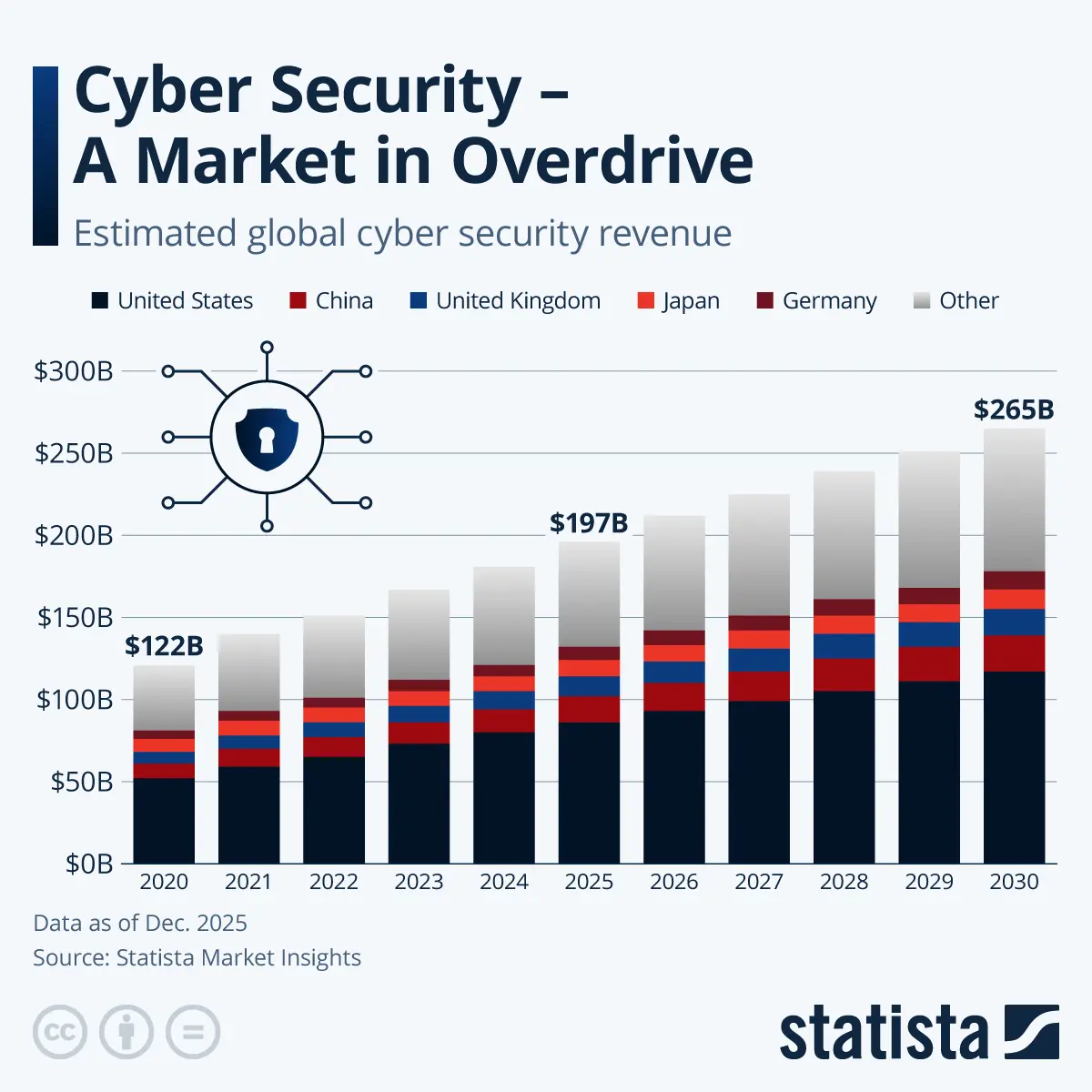
The numbers are moving in the same direction. Gartner projects $244 billion in worldwide information security spending in 2026. The FBI’s 2025 Internet Crime Report recorded $20.9 billion in reported losses across more than one million complaints. And Verizon’s 2026 Data Breach Investigations Report found that exploitation of vulnerabilities was the initial access vector in 31% of breaches, while a human element featured in 62%. These measures capture different parts of the problem, but all point to the same reality: security is no longer a peripheral IT function. It is core economic infrastructure.
Recent headlines make that dependence tangible. In November, disruptions involving the FAA, Microsoft services and JPMorgan Chase drew attention to the fragility of legacy systems and complex software dependencies; officials said these outages were not evidence of a coordinated cyberattack. Reuters reported that aging infrastructure and technical failures, rather than malicious intrusion, were behind several of the incidents. The distinction matters. Operational resilience and adversarial security are not interchangeable, but institutions need both.
AI adds another layer. It helps defenders discover weaknesses, simulate attacks and respond faster. It also gives malicious actors cheaper ways to personalize deception, probe systems and scale social engineering. The next three to four years will not eliminate these risks. We believe they will accelerate a shift toward more continuously tested, better authenticated and more resilient infrastructure. Three areas stand out.
I. From Reactive Defense to Proactive Testing
For decades, enterprise security has relied on a combination of perimeter controls, periodic penetration tests, annual training and incident response. These remain necessary. But a point-in-time assessment is a poor match for an environment in which applications change constantly, employees operate across multiple channels and attackers adapt their methods in real time.
The challenge is especially acute in financial services. Banks, insurers, payments companies and digital asset platforms sit at the intersection of sensitive information, high-value transactions and complicated third-party networks. A vulnerability may begin in software, but it can just as easily begin with a convincing phone call to an employee authorized to reset a credential or approve access.
This is the opportunity behind Mirage Security, an FGV Capital portfolio company building AI-native protection for the human layer of security. Mirage uses AI-driven social engineering simulations to test how employees respond to realistic phone, SMS, email and chat attacks. Its scenarios can reflect organizational context and current adversarial tactics, followed by personalized coaching and reporting through tools such as Slack and Microsoft Teams. Rather than measuring whether someone completed a generic training module, the approach tests whether an organization’s defenses work when a believable attack arrives.
Mirage’s own research makes the point. In its analysis of a ShinyHunters-style voice phishing campaign, the team examined cloned enterprise login pages and tracked 29 lookalike domains. The attackers used live authentication relays and deliberately steered victims away from phishing-resistant methods. In another investigation of hedge fund targeting, Mirage documented how a supposed IT security upgrade became the pretext for persuading employees to compromise their own accounts. The lesson is not that every attack requires sophisticated AI. It is that familiar business workflows can become effective attack surfaces.
The investment implication is straightforward: security programs must increasingly test the actual behavior of people and processes, not simply the existence of policies. Continuous adversarial simulation can expose the gap between the controls an organization believes it has and the decisions its employees make under pressure.
II. Deepfakes and the New Standard for Identity
The second shift is happening at the identity layer. For much of the digital era, we have treated possession as a proxy for trust: a password, a device, a one-time code or a familiar voice. Generative AI is weakening that assumption. A credible face, voice or video interaction can now be manufactured, while stolen credentials and compromised devices can make a fraudulent interaction appear routine.
The pace is notable. In its 2027 Identity Fraud Report, published in November 2026 and based on its own identity-verification data, Entrust reported a 165% year-over-year increase in detected deepfake attempts, averaging one every three minutes. Financial services represented roughly 94% of the deepfakes detected in that dataset, and detections targeting digital-first banks rose 714%. These are provider-observed trends, not a census of every attack worldwide, but they show how quickly the risk is evolving.
For financial institutions, the problem extends beyond onboarding. Consider a customer recovering an account, an executive authorizing a wire, a digital asset holder requesting a withdrawal or an employee seeking privileged access. A one-time code may prove control of a phone; it does not necessarily prove who is on the other side of the interaction, or whether that person is acting freely.
FGV Capital portfolio company FaceSign is building for this moment. Its live verification experience combines biometric matching, liveness checks, deepfake detection, behavioral signals and coercion screening to provide stronger assurance during high-risk actions. Rather than sending every sensitive interaction to a manual call center, FaceSign aims to deliver an automated verification flow in roughly 30 seconds. The company also creates audit logs and retains verification evidence, giving enterprise customers a record they can use in internal investigations and compliance workflows.
That final capability is important. In regulated financial services, stopping a fraudulent action is only one part of the problem. Institutions also need to demonstrate what was checked, when it was checked and why a decision was made. Evidence retention does not itself guarantee regulatory compliance, but it can make security controls more auditable and operationally useful.
We believe identity is moving from a one-time checkpoint to a contextual trust decision made whenever the risk warrants it. The winning systems will not ask customers to repeatedly prove themselves without reason. They will make higher assurance available precisely when the consequences of getting identity wrong are greatest.
III. When the Job Interview Becomes the Attack
The third shift brings these themes together. Some of the most damaging breaches begin not with a software exploit but with a relationship that appears legitimate: a recruiter, a candidate, a vendor, an IT administrator or a colleague. Hiring processes are particularly attractive because they routinely involve unfamiliar people, video calls, shared documents and requests to run technical assignments.
The stakes became unmistakable in October when Binance suffered a reported approximately $6.3 billion cryptocurrency theft. According to the exchange’s subsequent account, attackers spent months compromising employees and systems. One software engineer was approached through a legitimate job platform, participated in interviews with people impersonating a fictitious company and was directed to download a malicious coding assignment. Other compromised software and credentials contributed to the eventual theft. Binance said it froze approximately $2.85 billion in affected assets and took steps to replenish customer holdings. The initial interview was a social-engineering mechanism; public reporting does not establish that the interviewer used a deepfake.
This was not an isolated playbook. A September 2026 joint government advisory on the North Korean “Contagious Interview” campaign reported at least 30,000 compromised devices across more than 100 countries between roughly December 2025 and July 2026. The FBI has also warned that North Korean IT workers use fabricated identities and third-party facilitators to obtain jobs and access to enterprise systems. These are related but distinct tactics: fraudulent recruiters compromise job seekers, while fraudulent applicants seek trusted positions inside organizations.
The implication is broader than recruiting. Security teams need to evaluate whether the person initiating an interaction is genuine, whether the files or instructions they provide are safe, and whether a legitimate employee is being manipulated into taking an unsafe action. Traditional endpoint protection, identity controls and human judgment remain essential, but they need to work together across the full workflow.
This is an emerging expansion area for Mirage. Alongside its existing simulations, coaching and threat reporting, the company plans to bring fraudulent candidate screening into production over the coming months, extending its focus from measuring human risk to mitigating specific high-risk interactions. FaceSign’s identity-verification approach offers a complementary layer for situations where organizations need stronger assurance about the person on the other side of an interview or privileged request. Neither product should be viewed as a standalone answer to every recruitment attack. Together, they illustrate why cybersecurity, fraud prevention and identity are increasingly converging.
Building a More Resilient Digital Economy
Every major technology cycle has created new openings for bad actors. Email expanded the reach of phishing. Mobile applications and call centers introduced new forms of impersonation and account takeover. Digital payments increased the speed at which money could move, including when a transaction was fraudulent. AI is the next chapter in that progression, with a greater capacity to automate and personalize both attacks and defenses.
The near-term headlines can be unsettling. Yet the long-term opportunity is constructive. Better infrastructure will not emerge because threats disappear. It will emerge because companies build systems that are tested continuously, verify identity when it matters and intervene before a suspicious interaction becomes a loss.
At FGV Capital, this is why we are excited to back companies like Mirage Security and FaceSign. They approach different parts of the problem, but share an important conviction: trust cannot remain an assumption embedded in a workflow. It must become a capability that the workflow can establish, test and document.
The next generation of digital infrastructure will not be defined only by what it can automate. It will be defined by what people and institutions can trust it to do.